
Q-SYS Integration
How Runtech Engineers Networked Audio, Video and Control
SECTOR
ALL INDUSTRIES
SOLUTION
Q-SYS Integration
LOCATION
INTERNATIONAL
SECTOR
ALL INDUSTRIES
SOLUTION
Q-SYS Integration
LOCATION
INTERNATIONAL
Runtech is a UK-based AV integrator providing design, installation and support for corporate, retail, events and other organisations across the UK EMEA. Over the past few years, our work with Q-SYS has grown from loudspeaker and amplification systems into complete networked audio, video and control architectures.
In short: what is Q-SYS?
Q-SYS is a software-based AV platform from QSC that combines audio processing, video distribution and control in one networked system, with the Q-SYS Core as the central processor.
Runtech uses Q-SYS to design rooms and buildings where networked audio, AV over IP video, touch control and PTZ cameras operate as one architecture. Because it all runs over IP, the network becomes part of the AV design.
In this article
- How is a Q-SYS system different from a traditional AV system?
- What does the Q-SYS Core do?
- How does Q-SYS handle networked audio?
- How does Q-SYS handle AV over IP video?
- How does Q-SYS control work?
- Can Q-SYS integrate PTZ cameras?
- What network requirements does a Q-SYS system have?
- How do audio, video, control and network fit together?
- Runtech’s Q-SYS experience.
- Frequently asked questions about Q-SYS.
How is a Q-SYS system different from a traditional AV system?
A traditional AV system uses separate products for each job: a DSP for audio, a control processor for the room, a matrix or extenders for video and a panel or remote for the user. Each has its own configuration, signal paths and integration points. A Q-SYS system brings audio, video and control engines into the same software-based platform, with the Core orchestrating them across the network.
That changes the design question. Instead of asking which processor a room needs, the integrator asks how the entire AV system should communicate, process and distribute information.
| Feature | Traditional AV | Q-SYS platform |
|---|---|---|
| Audio processing | Standalone DSP | Q-SYS Core audio engine |
| Control | Separate control processor | Integrated Q-SYS control engine |
| Video distribution | Matrix switcher or extenders | AV over IP with Q-SYS NV Series endpoints |
| User interface | Separate panel or remote | Q-SYS touch control interfaces |
| Signal paths | Dedicated point-to-point cabling | Routed over the IP network |
| Configuration | Separate software for each subsystem | One software-based environment |
| Design question | Which processor does this room need? | How should the whole system communicate, process and distribute? |
What does the Q-SYS Core do?
The Q-SYS Core is the central processor of a Q-SYS system. It processes audio and control signals, orchestrates Q-SYS video distribution, and manages Q-SYS peripherals across the network, including their configuration and real-time device health. Runtech has deployed Core-based systems with both network and analogue I/O.
Because processing is not tied to where individual hardware sits, designers can distribute I/O and endpoints around a building while keeping one coherent processing architecture. Rooms no longer need a large local rack with dedicated processing for every function.
How does Q-SYS handle networked audio?
Q-SYS moves audio over the network using Q-LAN, its networked audio transport, and Runtech also uses Dante connectivity where a project needs it. Audio sources, processing and outputs are routed across the network instead of relying only on point-to-point analogue paths.
In practice, a microphone input doesn’t need to be next to the DSP, an amplifier doesn’t need to sit beside the processor, and a loudspeaker system can be spread throughout a space while remaining part of one logical audio system. Loudspeakers and amplification remain core building blocks of our Q-SYS projects, but they now sit inside a networked architecture.
How does Q-SYS handle AV over IP video?
Q-SYS goes beyond audio through its NV Series network video endpoints, which carry HDMI sources and displays over the Q-SYS network. Video is encoded, transported across the network and decoded at its destination, rather than being wired as a dedicated physical connection from each source to each display.
The NV-32-H, for example, can be configured in software as an encoder or decoder for networked HDMI distribution. It can also operate in Core Mode, which adds processing and local HDMI switching. This suits projects where several sources must reach several displays, or where source and display locations make a traditional matrix impractical. Video also becomes part of the same architecture as audio and control.
How does Q-SYS control work?
Q-SYS includes a dedicated control engine, so control interfaces interact directly with the audio and video systems rather than sitting alongside them. Runtech deploys Q-SYS touch control interfaces that give users one consistent way to operate a room.
A single command can trigger several actions at once, such as changing a display source while adjusting audio routing, microphone behaviour and room settings. Q-SYS also integrates with third-party equipment through its open architecture, APIs, scripting and partner ecosystem, so control is designed in from the start rather than added after the hardware is chosen.
Can Q-SYS integrate PTZ cameras?
Yes. Q-SYS supports network cameras alongside its audio, video and control architecture, and Runtech has expanded into networked PTZ camera systems. In a modern collaboration space, the camera is another system endpoint, and camera selection, video distribution, user control, conferencing interfaces and room audio can form one workflow.
The NV Series can also bridge between Q-SYS devices and conferencing applications. This lets us plan the relationship between camera, microphone, loudspeaker, display and user interface from the start of the design.
What network requirements does a Q-SYS system have?
Once audio, video and control travel over IP, the network is part of the AV system. Q-SYS uses IP-based networking for audio, video, device discovery, synchronisation, control and management, and it requires network performance suited to real-time media, with quality of service used to prioritise time-sensitive clocking, audio and video traffic. Q-SYS networking guidance covers Layer 2 and Layer 3 deployments and PTP timing. A Q-SYS design has to address:
- Topology and redundancy: switch layout and resilience
- Segmentation and handling: VLAN configuration and endpoint addressing
- Traffic handling: multicast behaviour, quality of service and traffic prioritisation
- Capacity and timing: bandwidth, latency, jitter and PTP clock synchronisation
- Operations: device discovery, monitoring and management
This makes early coordination between the AV integrator and the IT or network team essential, and it is why Q-SYS projects at Runtech involve AV engineering and network infrastructure working together.
How do audio, video, control and network fit together?
In a Q-SYS system, these are functional layers of one architecture rather than separate systems. A single Runtech design can include all of the following:
| System | Signal flow |
|---|---|
| Audio |
|
| Video |
|
| Control |
|
| Cameras |
|
| Network |
|
Runtech's Q-SYS experience
Since 2024 the number of Q-SYS projects Runtech has delivered 29 Q-SYS projects.
Scope growth matters as much as volume growth. Our early projects centred on loudspeakers and amplification. Our current projects add centralised Core processing, networked audio, Dante, AV over IP video, touch control, PTZ cameras and third-party integration. The change is less about what we install and more about how we engineer the system.
Project example
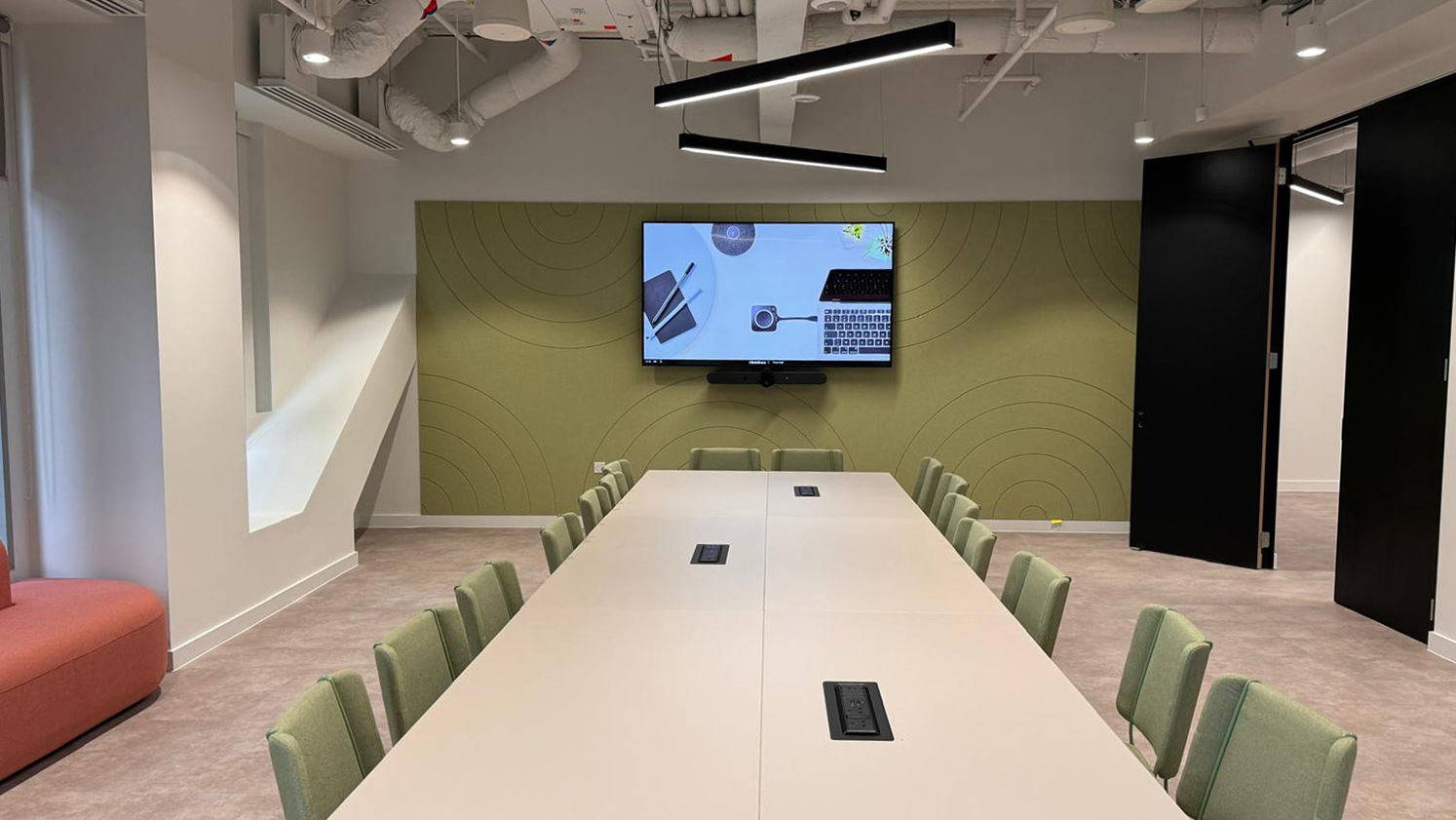
Runtech was brought in to design and install the AV for Huckletree’s new four-floor hub at Liverpool Street, delivering a BYOD-ready setup across meeting rooms, an event space, breakout areas and a podcast room. Q-SYS QSC pendant ceiling speakers provide even background music throughout the common areas, and their white finish blends in with the hub’s colourful ceilings.
What stands out with Q-SYS is how much more connected the system becomes during commissioning. We’re not just checking individual audio or video components; we’re looking at how the Core, networked audio, video endpoints, control interfaces and third-party devices are all communicating as one system. That gives us much greater visibility during commissioning and allows us to fine-tune the system as a complete architecture, rather than troubleshooting each element in isolation.
Runtech Commissioning Engineer
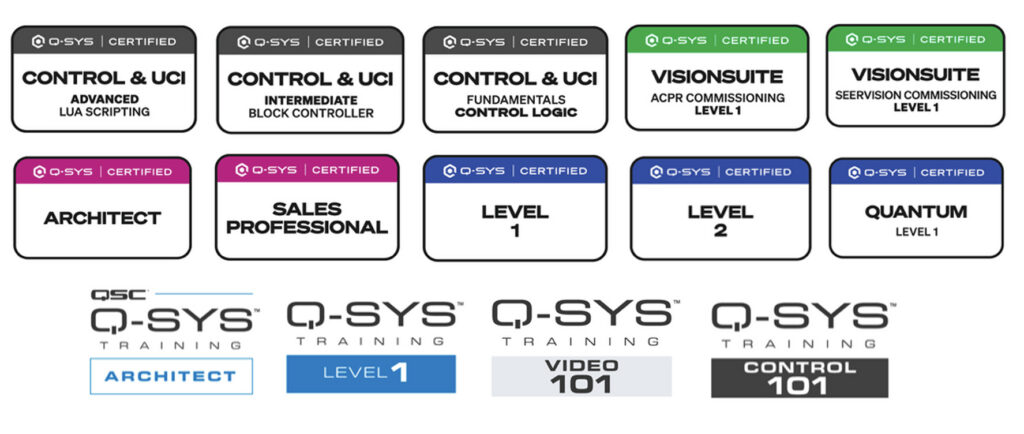
Credentials
Frequently asked questions about Q-SYS
Q-SYS is a software-based AV platform from QSC that brings audio processing, video distribution and control into one networked system. The Q-SYS Core acts as the central processor, and peripherals, endpoints and control interfaces connect to it over an IP network. Integrators configure the whole system in a single software environment.
A Q-SYS integrator designs, specifies, programmes and commissions Q-SYS systems, and coordinates the network they run on. At Runtech, that includes core processing, networked audio, AV over IP video, touch control, PTZ cameras, and third-party equipment integration.
Q-SYS carries real-time audio, video, clocking and control over IP, so it needs a network configured for that traffic, with suitable bandwidth, VLANs, multicast handling, quality of service and PTP timing. Some projects use dedicated switches, and others share the wider IT network. Either way, agree on the design with the IT team in advance.
Q-LAN is the networked audio transport used between Q-SYS devices. Dante is a separate, widely used audio-over-IP protocol found in equipment from many manufacturers. Runtech uses Q-LAN within Q-SYS systems and adds Dante connectivity where a project needs to connect Dante-enabled equipment.
In many projects, yes. Q-SYS NV Series endpoints encode, transport and decode HDMI video over the network so that sources can reach displays lacking dedicated point-to-point cabling. Whether it suits a particular room depends on the number of sources and displays, latency and resolution requirements, and network capacity, so we assess each project individually.
The NV-32-H is a Q-SYS network video endpoint that can be configured in software as an encoder or a decoder for HDMI video over the network. It can also operate in Core Mode, which adds processing and local HDMI switching.
Yes. Q-SYS has an open architecture with APIs, scripting, and a partner ecosystem, allowing its control engine to integrate with third-party displays, devices, and room systems.
Talk to Runtech about your Q-SYS project.
If you are planning a Q-SYS system, from a single collaboration space to a distributed multi-room installation, our engineers can advise on architecture, network design and control from the start.
+44 (0) 203 640 6030